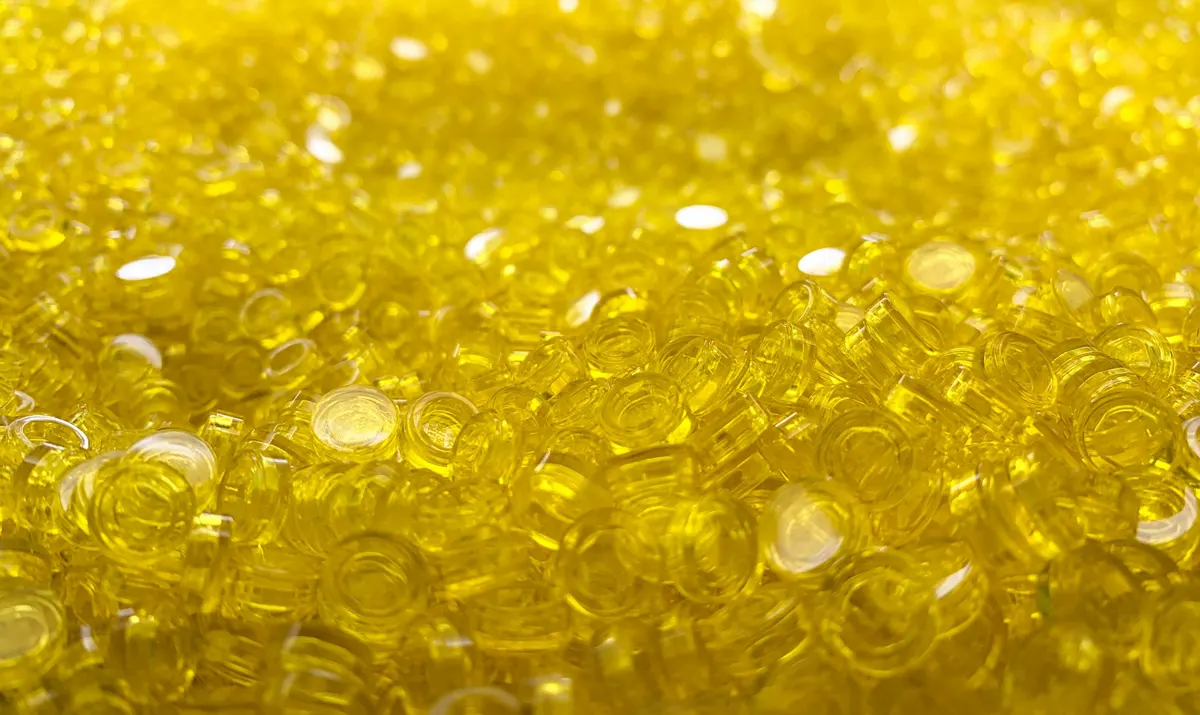
Polyethylene is the plastic made from ethylene. It is a thermoplastic: it softens with heat, can be molded, and becomes solid again as it cools. That is why it reaches the factory as pellets, ready for the extruder or the injection molding machine.
How polyethylene is made
Ethylene, a gas derived from oil or natural gas, is polymerized: the small molecules link into long chains. The way this linking is done defines the type of polyethylene.
- High pressure: produces chains with long branches, yielding LDPE.
- Catalysts (Ziegler-Natta or metallocene): produce linear chains. Without a comonomer you get HDPE; with a comonomer (butene, hexene or octene) you get LLDPE.
Types of polyethylene by density
| Type | Typical density (g/cm³) | Structure | Typical use |
|---|---|---|---|
| LDPE | 0.910 to 0.925 | long branches | transparent film |
| LLDPE | 0.915 to 0.940 | linear with short branches | stretch film, heavy-duty sacks |
| MDPE | 0.926 to 0.940 | intermediate | heavier-gauge film, pipe |
| HDPE | 0.941 to 0.965 | linear, almost no branching | bottles, parts, pipes |
General ranges. The value for each grade is on the manufacturer's technical data sheet.
Why density matters
The less branched the chain, the more tightly the molecules pack and the denser the material. Higher density means a more rigid part that is more resistant to chemicals; lower density means a more flexible, transparent film. That is why every resin's technical data sheet lists density in g/cm³ and melt flow index in g/10 min.
Where each polyethylene is used
- LDPE: transparent blown film, packaging, blends with LLDPE. See the LDPE resin.
- LLDPE: stretch film, heavy-duty sacks, agricultural film, industrial film. See the LLDPE resin.
- HDPE: blow-molded bottles and drums, injection-molded parts, bags, pipes. See the HDPE resin.
Is polyethylene recyclable?
Yes. It has its own symbol in the recycling triangle: 2 for HDPE and 4 for LDPE. Once washed and reprocessed, it becomes pellets again for new parts.